

Intro
There is a persistent myth in the skincare world: "If it stings, it’s working."
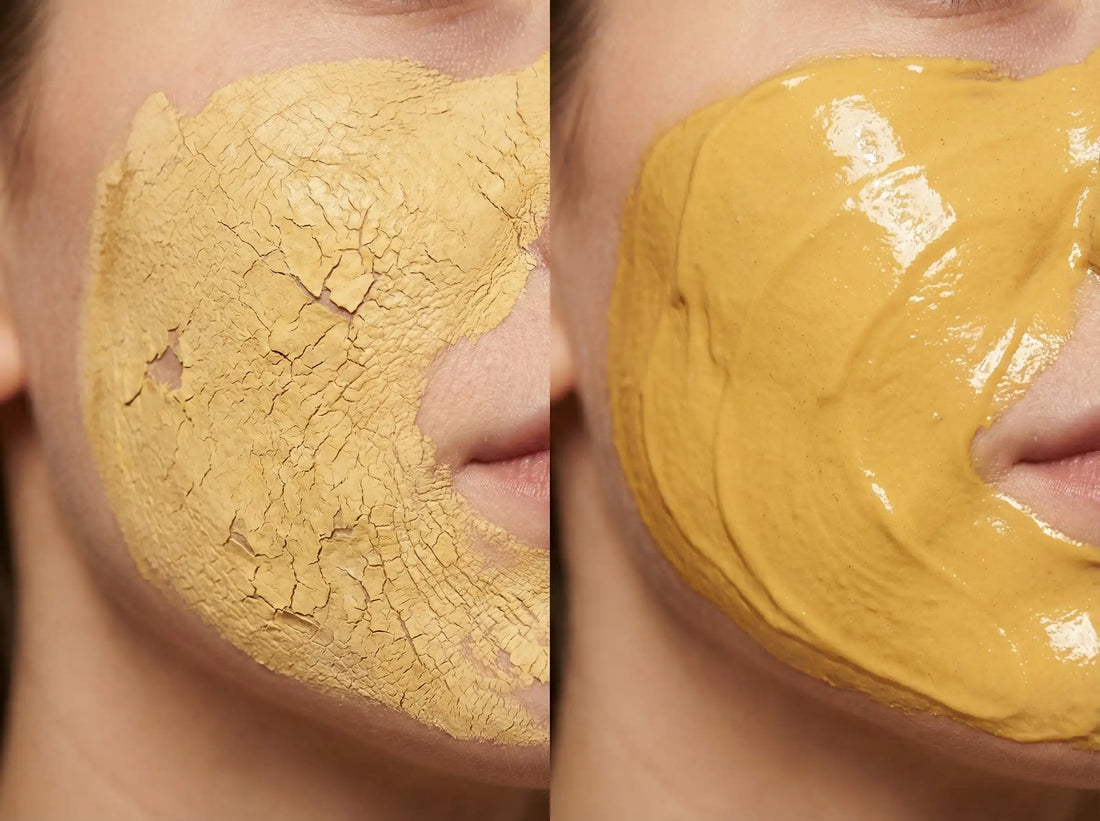
Nowhere is this more prevalent than with clay masks. We have been taught that a clay mask should tighten until we can’t move our faces, crack like a desert floor, and leave our skin feeling "squeaky" clean. But from a dermatological perspective, that sensation isn't deep cleaning—it is barrier impairment.
If you have been asking, "does a clay mask damage skin barrier?" the answer is yes—if it is unbuffered.
At Fulkhari, we advocate for a formulation philosophy we call Buffered Clay. It is the reason our masks feel creamy rather than chalky, and it is rooted in both modern chemistry and ancient Ayurvedic wisdom.
The Science of "Stripping": How Raw Clay Works
To understand why buffering is necessary, we must look at how raw Fuller's Earth (Multani Mitti) interacts with water and skin.
1. Capillary Action
Clay is hydrophilic (water-loving). When you mix raw clay powder with water and apply it to your face, the water begins to evaporate immediately. As the water leaves the clay, the clay pulls moisture from the nearest available source to replace it: your skin cells.
2. Osmotic Shock
If a mask dries completely (the "cracking" stage), it triggers a rapid shift in hydration levels. It absorbs not just excess sebum (oil), but also the Natural Moisturizing Factors (NMFs) and essential lipids that hold your skin cells together. This aggressive dehydration creates micro-cracks in the skin barrier, leading to redness, rebound oiliness, and sensitivity.
Enter "Buffered Clay": The Solution
Buffered Clay is the practice of pre-saturating the clay's absorptive matrix with lipids (oils) or humectants (honey, glycerin) before it touches the skin.
How It Works Scientifically:
- Reduced Surface Tension: By mixing clay with a lipid like Almond Oil, we coat the clay particles. This slows down the rate of evaporation, keeping the mask flexible on the skin.
- Selective Absorption: Because the clay is partially saturated with healthy oils, it is less "thirsty." It still possesses the magnetic charge to draw out positively charged toxins and surface debris, but it no longer aggressively strips water from your cells.
- Barrier Support: Instead of taking away, a buffered mask deposits nutrients. As the clay warms on your skin, it helps push the buffer ingredients (like Vitamin E from oil or enzymes from honey) deeper into the pores.

Ancient Roots: They Knew Better Than Water
This concept of buffering isn't a modern invention; it is a rediscovery of traditional methods. If you look at heritage recipes in India, Multani Mitti was rarely used with plain water.
- The "Ubtan" Buffer: Clay was mixed with Milk or Yogurt. The lactic acid exfoliated, but the milk fats buffered the clay to prevent drying.
- The "Winter" Buffer: In colder months, clay was mixed with Honey. Honey is a natural humectant, meaning it grabs moisture and holds it against the skin, counteracting the drying nature of the earth.
Our ancestors didn't have microscopes to see the skin barrier, but they understood the feeling of balance. Learn more about these traditional mixes in The Ubtan Legacy.
The Fulkhari Standard: Pre-Buffered for Safety
We formulated Fulkhari masks to ensure you never have to worry about mixing ratios or damaging your barrier. We use "Pre-Buffered" formulations tailored to skin needs.
1. The Lipid Buffer (For Dry/Dull Skin)
In our Golden Sunset Mask, we buffer Fuller's Earth with Sweet Almond Oil and Honey Powder. The oil creates a protective seal, ensuring the clay brightens and exfoliates without stripping essential moisture.
2. The Botanical Buffer (For Sensitive Skin)
For Rose Meadows, we use Sandalwood and Rose oils. These act as anti-inflammatory agents, cooling the skin on contact to counteract the heat that often comes with detoxification.
3. The Hydration Buffer (For Oily Skin)
Even oily skin needs a barrier. In Oasis Sands, we buffer with Aloe Vera. This provides water-based hydration that keeps the clay active and effective against acne bacteria, without leaving the skin dehydrated and prone to more breakouts.
How to Protect Your Barrier While Masking
Even with a buffered mask, healthy habits are essential.
- The 10-Minute Rule: Rinse the mask off while it is still "sticky-dry." If it flakes when you smile, it has been on too long.
- Avoid Hot Water: Heat melts natural skin lipids. Always rinse with lukewarm or cool water.
- Seal Immediately: Apply your moisturizer within 60 seconds of rinsing to lock in the hydration provided by the buffer ingredients.
The Takeaway
Clay is one of nature's most powerful detoxifiers, but power requires control. By understanding the science of Buffered Clay, you can stop fearing the "dry down" and start enjoying the deep, restorative cleanse that Fuller's Earth is meant to provide. It is not just about cleaning the skin; it is about respecting the ecosystem that protects it.
Experience the science of Buffered Clay.
Shop our barrier-safe collection: View All Masks.
Frequently Asked Questions
Does a clay mask damage the skin barrier?
Raw clay mixed only with water can damage the skin barrier by causing "osmotic shock"—rapidly pulling water out of skin cells. However, "Buffered Clay" (mixed with oil, honey, or aloe) is safe and protects the barrier while cleansing.
Why does my face get red after a clay mask?
Redness can be a sign of increased circulation (which is good) or barrier irritation (which is bad). If the redness creates a burning sensation or lasts more than 30 minutes, your clay was likely too harsh or left on too long, damaging the lipid barrier.
How do I fix my skin barrier after a clay mask?
If you have over-stripped your skin, pause all active treatments (retinol, acids) for 3 days. Focus on hydration: use a gentle cleanser, apply a hyaluronic acid serum, and seal with a rich moisturizer or facial oil.