

Intro
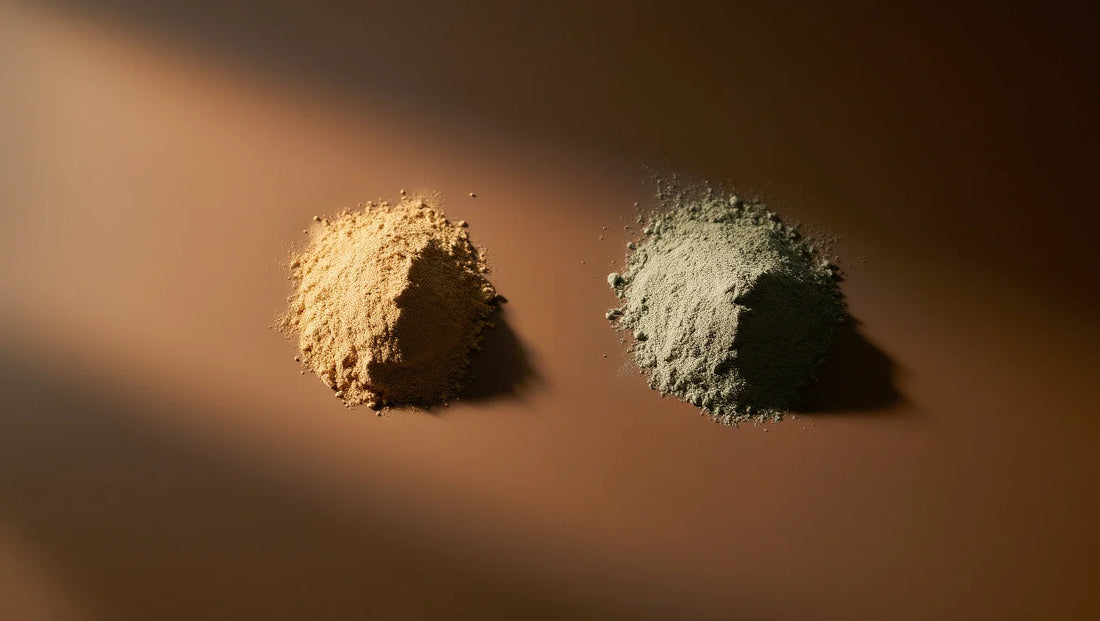
When you are looking to deep clean your pores, two heavyweights often dominate the conversation: Fuller's Earth (Multani Mitti) and Bentonite Clay. Both are powerful, mineral-rich ingredients known for detoxifying the skin, but they work in distinctly different ways.

The short answer?
While both clays absorb oil, Bentonite Clay is famous for its "swelling" ability and electrical charge that draws out deep toxins, often creating a pulsing sensation. Fuller's Earth, on the other hand, is uniquely renowned for its cooling properties and ability to tackle pigmentation and discoloration while absorbing oil.
If you are trying to choose between the two, the decision comes down to your specific skin concerns: are you looking for a heavy-metal detox (Bentonite) or a brightening, oil-balancing glow (Fuller's Earth)?
What is Bentonite Clay?
Bentonite clay is composed of aged volcanic ash. It is often grey or cream-colored and has a unique physical characteristic: when mixed with water, it swells like a sponge.
Scientifically, Bentonite is a "swelling clay" with a strong negative electrical charge. When applied to the skin, it creates a pulsing sensation for many users. This indicates its strong "drawing" power, pulling heavy metals and toxins from the skin. It is exceptionally effective, but its intensity can sometimes disrupt the moisture barrier if used too frequently or on sensitive skin.
What is Fuller's Earth (Multani Mitti)?
Fuller's Earth, known in South Asia as Multani Mitti, is a sedimentary clay rich in aluminum magnesium silicate. Unlike Bentonite, it does not swell significantly when wet.
Its primary strength lies in absorption and cooling. In traditional Indian beauty practices, it is prized not just for removing oil, but for "de-tanning" (removing dead skin cells and pigmentation) and soothing heat-induced rashes. It acts as a gentle exfoliant and a cooling agent, making it ideal for inflamed, acne-prone skin that needs calming rather than just aggressive extraction.

Key Differences: How They Work on Skin
While both are clays, their mechanisms on the skin differ. Understanding this helps explain why we chose Fuller's Earth for Fulkhari's formulations.
1. Oil Absorption vs. Toxin Removal
Bentonite: Focuses on adsorption. It binds to toxins and heavy metals like a magnet. It is excellent for a deep chemical detox of the pores.
Fuller's Earth: Focuses on absorption. It soaks up oils (sebum) and impurities like a blotter. Research suggests Fuller's Earth can absorb a massive amount of oil relative to its mass, making it incredibly effective for matte results without the aggressive "pulsing" feeling of Bentonite.
2. Brightening vs. Purifying
This is the major differentiator. Bentonite cleanses, but Fuller's Earth brightens.
Fuller's Earth has mild bleaching properties (natural, not chemical) and is excellent at exfoliating dead skin cells. This makes it the better choice for fading acne scars (hyperpigmentation), sun spots, and uneven skin tone.
Bentonite is strictly a detoxifier; it does not typically address pigmentation issues.
3. Cooling vs. Heating
Bentonite: Often increases circulation rapidly, leading to a red, flushed face and a sensation of heat or pulsing.
Fuller's Earth: Is naturally cooling (sheetal in Ayurveda). It reduces the temperature of the skin, calming redness and soothing active, angry pimples.
The Fulkhari Perspective: Why We Chose Fuller's Earth
We chose Fuller's Earth for the Golden Sunset, Rose Meadows, and Oasis Sands masks because it offers that rare balance: powerful purification with a cooling, brightening finish that respects the skin barrier.
But here's what really set it apart: Fuller's Earth doesn't just pull impurities out, it exchanges them for beneficial minerals. While Bentonite is exceptional at drawing out toxins, Fuller's Earth performs a more nuanced dance with your skin, leaving it clarified without that tight, stripped feeling that makes you reach for moisturizer immediately.
That said, both clays have their place in skincare.
Which Clay is Right for You?
Use this guide to match the clay to your specific skin needs.
Choose Bentonite Clay if:
- You have very resilient, non-sensitive skin.
- You are dealing with deep, cystic acne and need a heavy-duty detox.
- You do not mind temporary redness or a pulsing sensation.
- Pigmentation is not your primary concern.
Choose Fuller's Earth (Multani Mitti) if:
- You have oily or combination skin and want to control shine.
- You struggle with dark spots, acne scars, or dullness.
- You have active, red breakouts that need soothing, not just drying.
- You want a mask that creates a "glow" rather than just a deep clean.
- You prefer a cooling sensation over a heating one.

Can You Mix Them?
Yes, many skincare enthusiasts mix the two to get the detox benefits of Bentonite with the brightening effects of Fuller's Earth. However, at Fulkhari, we prefer to pair Fuller's Earth with complementary nourishing botanicals such as Turmeric or Sandalwood. This maximizes the brightening and soothing properties without risking the over-drying effect that can come from mixing two powerful clays together.
Conclusion
Both Bentonite and Fuller's Earth are incredible gifts from nature. If your goal is heavy-metal detoxification, Bentonite is a strong contender. But for a holistic skincare routine that targets oil, fights acne, soothes inflammation, and leaves you with a radiant glow, Fuller's Earth is the versatile winner.
By choosing Fuller's Earth, specifically the cosmetic-grade clay used in Fulkhari masks, you are choosing a time-tested path to clarity and radiance. Ready to experience the cooling difference? Discover the brightening power of Fuller's Earth in our Golden Sunset Clay Mask.
Frequently Asked Questions
Is Fuller's Earth better than Bentonite Clay for acne?
For inflammatory, red acne, Fuller's Earth is often better because it has cooling properties that soothe irritation while absorbing oil. Bentonite Clay is effective for deep cystic acne detoxing but can sometimes be too stimulating for inflamed skin.
Which clay is best for skin whitening or brightening?
Fuller's Earth (Multani Mitti) is superior for brightening. It has mild exfoliating and bleaching properties that help fade dark spots and pigmentation, whereas Bentonite Clay focuses primarily on drawing out toxins.
Can I mix Bentonite Clay and Fuller's Earth together?
Yes, you can mix them to combine deep detoxing with oil absorption. However, this creates a very potent mask that can be drying. We recommend using a pre-formulated Fuller's Earth mask with hydrating botanicals for a safer, more balanced result.