

Updated November 2026 with current research.
Yes, turmeric can be good for your skin, with a few honest caveats. Its main active compound, curcumin, has anti-inflammatory and antioxidant activity, and early clinical studies on skin are encouraging. But the research is still preliminary, plain turmeric paste can stain, and a small number of people are allergic to it. Here is what turmeric does, what the evidence actually supports, and how to use it well.
What is turmeric?

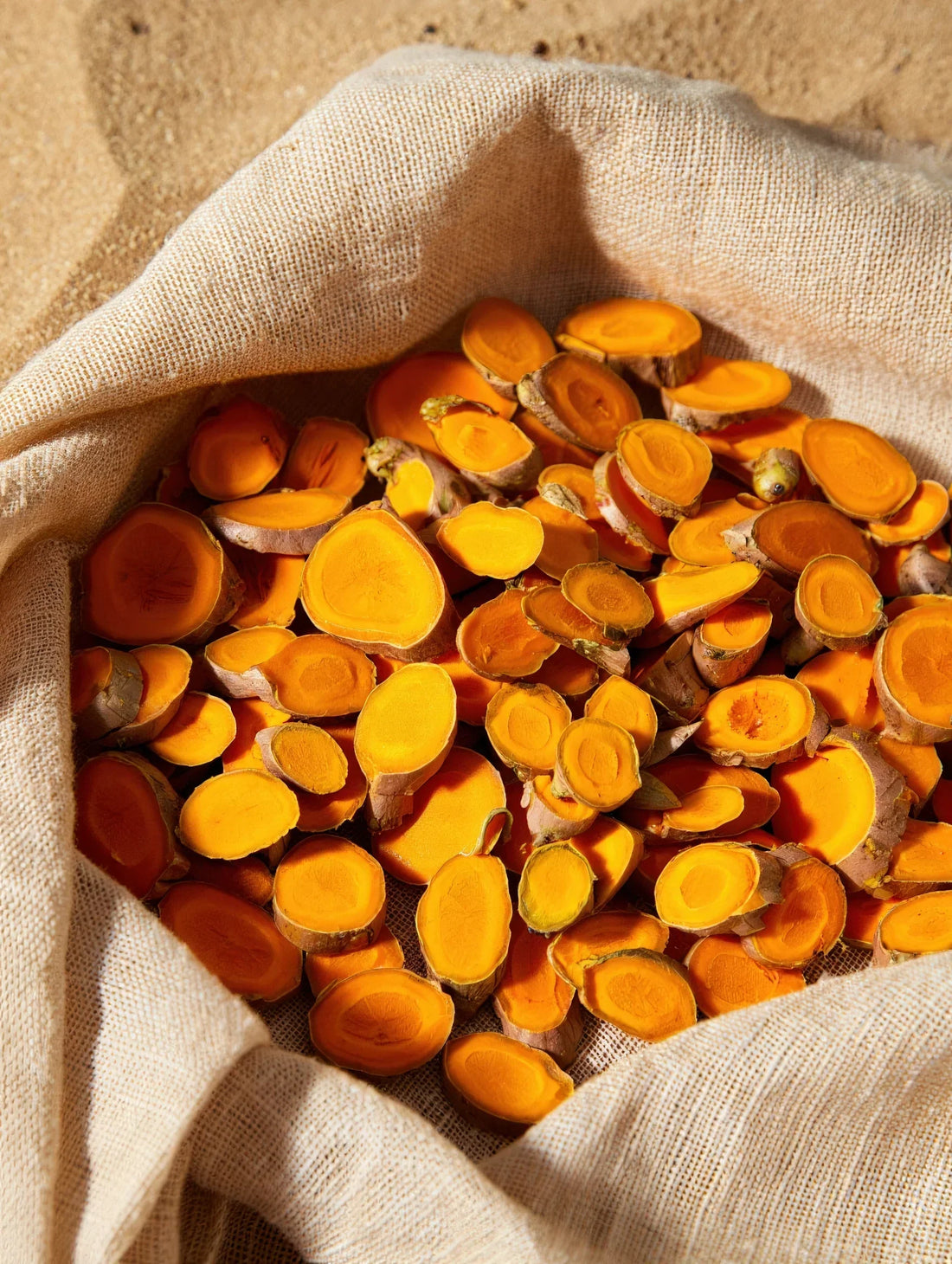
Turmeric (Curcuma longa) is a root in the ginger family, known for its deep golden-yellow colour. In South Asia it is called haldi, and it is part of everyday cooking and family traditions, including the pre-wedding haldi ceremony, where a turmeric paste is applied to the bride and groom. For generations it has also been ground into simple pastes and face packs, often alongside ingredients like chickpea flour, yogurt and Multani Mitti (Fuller's Earth).
Most of turmeric's skin interest comes from curcumin, the compound that also gives it its colour.
What the research says about turmeric and skin
The most thorough look at the evidence is a systematic review of human clinical studies. It found 18 studies that met its criteria: 8 tested turmeric or curcumin applied to the skin, 9 tested it taken by mouth, and 1 tested both. Ten of the 18 reported a statistically significant improvement compared with control groups, but the authors described the evidence as preliminary and called for larger, better studies (Vaughn et al., 2016). A 2024 review reached a similar conclusion: curcumin showed a good safety profile across clinical trials, but the best dose and way to use it are still unclear (Archives of Dermatological Research, 2024).
| What people use it for | What the evidence says | How strong |
|---|---|---|
| Calming redness and irritation | Curcumin has clear anti-inflammatory activity in laboratory research, and some small clinical studies on skin reported improvement. | Promising, early |
| Protecting against environmental stress | Curcumin is a strong antioxidant in the lab, which is why it is studied for skin ageing. Human skin data are limited. | Mostly lab-based |
| A more even-looking tone | Lab studies suggest curcumin can interfere with pigment production. Clinical evidence on dark spots is small and short-term. | Early |
| Breakout-prone skin | Acne was one of the conditions included in the clinical studies reviewed, but the studies were small and varied. | Early |
In short: turmeric is one of the better-studied traditional ingredients, but "promising" is still the honest word. Be wary of anyone promising dramatic results.
Why kitchen turmeric is not the same as a formulated product

It stains. Curcumin is a strong natural dye, so raw turmeric can leave a yellow tint on skin and fabric.
It is delicate. Curcumin dissolves poorly in water and breaks down with light and time, so a paste made in a bowl delivers very little of it to your skin.
Formulas handle both problems. Skincare products use measured amounts of turmeric or its extracts, often paired with ingredients that help carry it, and some extracts are processed to reduce staining.
How turmeric is processed for skincare
Harvesting and cleaning. The rhizomes (the root-like stems) are dug up and washed to remove soil.
Boiling or steaming. Fresh roots are usually cooked briefly, which evens out the colour and helps them dry.
Drying. The roots are dried completely, traditionally in the sun. Gentle drying is generally preferred because curcumin is sensitive to heat and light.
Polishing and grinding. The dried roots are polished and ground into the familiar golden powder.
Extracts. For many formulas, the powder is steeped in a carrier such as glycerin or oil to concentrate its active compounds into an extract that mixes more easily.
Who should be careful with turmeric
Turmeric is well tolerated by most people, but it is not risk-free. Curcumin is a recognised contact allergen, and allergic skin reactions have been reported from turmeric pastes, turmeric-containing cosmetics and workplace exposure to the spice (Curcumin: a contact allergen; Indian Dermatology Online Journal, 2023).
- Patch test first on your jawline for 24 hours.
- Skip it on broken or irritated skin.
- Stop if you notice itching, redness or swelling, and avoid turmeric if you already react to it in food or other products.
For more on patch testing and clay masks, see Multani Mitti side effects.
How to use turmeric on your skin
Use a pinch, not a spoonful. A small amount mixed into a clay, yogurt or chickpea flour base is enough and keeps staining down.
Keep it short. Ten to fifteen minutes, then rinse with lukewarm water before the mask dries completely.
Lift any tint. An oil-based cleanser or a little milk on a cotton pad removes leftover yellow.
Pair it well. The traditional ubtan combines turmeric with chickpea flour and yogurt, and our Multani Mitti face pack recipes include several turmeric options. Other traditional ingredients worth knowing are sandalwood and saffron.
If you would rather skip the mixing and the yellow fingers, our Golden Sunset mask pairs turmeric with Multani Mitti (Fuller's Earth), honey and almond in a ready-to-use formula for normal skin.
The takeaway
Turmeric is a well-loved ingredient with real, if still early, science behind it. Curcumin's anti-inflammatory and antioxidant activity make it a sensible supporting ingredient for skin that looks dull or a little reactive. Use a small amount, keep it brief, patch test first, and keep your expectations grounded: it supports healthy-looking skin, it does not replace sunscreen or treatment for a skin condition.
Frequently Asked Questions
Is turmeric good for your skin?
For most people, yes, in moderation. Curcumin, turmeric's main compound, has anti-inflammatory and antioxidant activity, and early clinical studies on skin are encouraging. The research is still preliminary, so think of turmeric as a helpful supporting ingredient rather than a fix.
Does turmeric lighten skin permanently?
No. Turmeric does not change your natural skin tone. At most it may help skin look a little more even and bright over time, and that effect fades if you stop. Daily sunscreen does far more to prevent dark spots than any mask.
Will turmeric stain my skin?
Raw turmeric can leave a temporary yellow tint, especially on fair skin. Use only a pinch, mix it into a clay or yogurt base, and remove any leftover tint with an oil-based cleanser or a little milk on a cotton pad. It also stains fabric and grout, so protect towels and counters.
Is haldi good for the face?
Haldi is the Hindi name for turmeric, so the answer is the same: used sparingly and patch tested first, it suits most skin types. People with sensitive skin or a known spice allergy should be cautious.
How often can I use a turmeric face mask?
Once or twice a week is plenty. Leave it on for 10 to 15 minutes and rinse before it dries completely.
Can I leave turmeric on my face overnight?
No. Long contact raises the chance of staining and irritation. Keep it to a short mask and rinse well.
References
- Vaughn AR, Branum A, Sivamani RK. Effects of turmeric (Curcuma longa) on skin health: a systematic review of the clinical evidence. Phytotherapy Research, 2016;30(8):1243–1264. PubMed 27213821
- Systematic review of turmeric and curcumin in dermatology. Archives of Dermatological Research, 2024. doi:10.1007/s00403-023-02754-8
- Curcumin: a contact allergen. Review, 2015. PubMed 26705440
- Indian Dermatology Online Journal, 2023;14:459 (turmeric and skin reactions). PMC10373802