

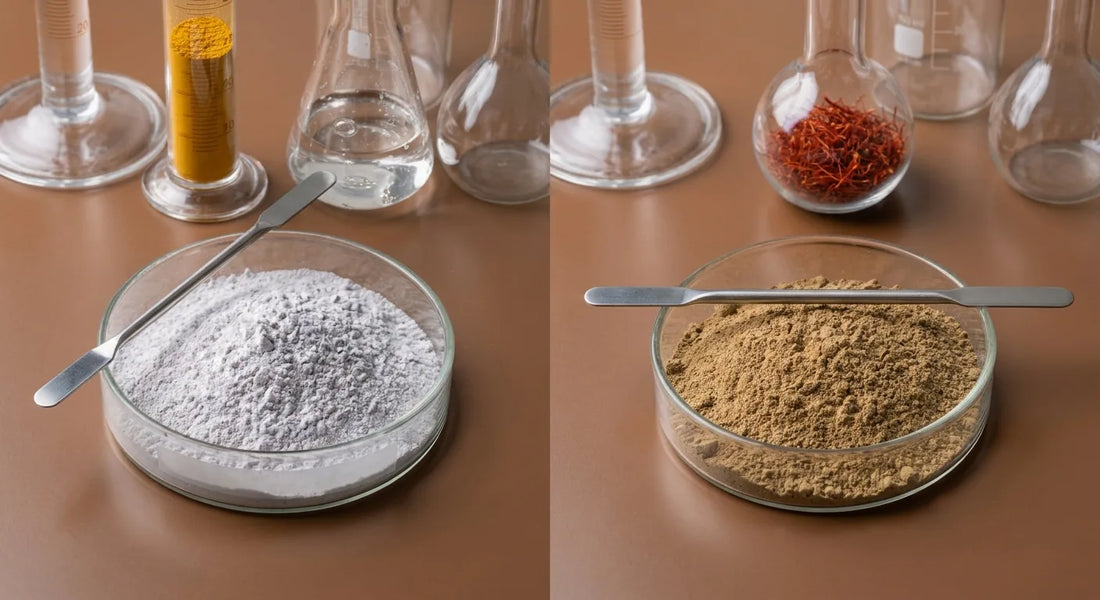
Kaolin clay is the gentler of the two; Multani Mitti (Fuller's Earth) is the stronger oil-absorber. If your skin is dry, sensitive, or new to clay masks, kaolin is the safer starting point. If your skin is oily, congested, or prone to a shiny T-zone, Multani Mitti (Fuller's Earth) does more of the work you actually want a clay mask to do. The difference isn't marketing. It comes down to how each clay is built at the mineral level.
Below is a side-by-side breakdown of what each clay is, why they behave so differently on skin, and how to choose between them for your skin type.
Kaolin vs. Multani Mitti at a glance
| Kaolin clay | Multani Mitti (Fuller's Earth) | |
|---|---|---|
| Also called | White clay, China clay | Fuller's Earth, "mud of Multan" |
| Main mineral | Kaolinite | Typically montmorillonite-rich (a smectite clay) |
| Oil absorption | Mild | Strong |
| Swells in water? | Very little | Yes, noticeably |
| Feel on skin | Soft, light, barely tightens | Firmer, tightens as it dries |
| Best for | Dry, sensitive, mature skin; first-time clay users | Oily, combination and congested skin |
| Typical frequency | Up to 2–3 times a week | 1–2 times a week |
What is kaolin clay?
Kaolin clay is a soft, fine clay made mostly of the mineral kaolinite, a hydrated aluminum silicate. It takes its name from Gaoling (historically written "Kao-ling"), a hill near Jingdezhen in China whose white clay was used for porcelain. That porcelain history explains the "China clay" nickname.
In skincare, kaolin is most often sold as white kaolin. Pink, red, and yellow "kaolin" products are usually kaolin blended with iron-rich clays for colour, which slightly changes how they feel on skin.
What is Multani Mitti (Fuller's Earth)?
Multani Mitti (Fuller's Earth) is a highly absorbent clay that has been used for skin and hair across South Asia for generations. "Multani Mitti" means "mud from Multan," the region historically associated with it. "Fuller's Earth" comes from the old wool trade, where "fullers" used the clay to pull grease and lanolin out of raw wool, which is a useful clue to how strongly it absorbs oil.
"Fuller's Earth" is a name for a family of absorbent clays rather than a single mineral. The Multani Mitti used in skincare is typically rich in montmorillonite, a smectite clay. For a deeper look at the ingredient itself, read our complete guide to Multani Mitti (Fuller's Earth).
Why they behave so differently: the mineral structure
The difference between kaolin and Multani Mitti (Fuller's Earth) comes from how their mineral layers are stacked.
Kaolinite: tightly bonded, low-charge layers. Kaolinite is a "1:1" clay: each layer pairs one silica sheet with one alumina sheet, and the layers are held tightly together. Water and oil can't easily get between them, so kaolin swells very little and has a low cation exchange capacity, meaning its surface holds relatively few charged sites for binding other substances. On skin, this translates to gentle, surface-level absorption.
Montmorillonite: expandable, high-charge layers. Montmorillonite is a "2:1" clay: each layer sandwiches an alumina sheet between two silica sheets, and the space between layers can open up when wet. That is why Multani Mitti (Fuller's Earth) swells and why it has a much higher cation exchange capacity than kaolin. More surface area and more charged sites mean it absorbs more sebum and binds more surface debris. Used carelessly, it can also pull more of the skin's own moisture too.
This is the same reason Multani Mitti can feel drying on its own: the clay keeps pulling moisture as it dries. We explain how to counter that in What is "Buffered Clay"?
Kaolin and Multani Mitti (Fuller's Earth) sit at opposite ends of the clay spectrum, but they aren't the only options. Bentonite is another montmorillonite-based clay that is even more absorbent than most Multani Mitti. If you're deciding between the stronger clays, see Fuller's Earth vs. Bentonite Clay.
Which clay is better for your skin type?
Oily or congested skin: Multani Mitti (Fuller's Earth). Oily skin benefits most from a clay that can absorb meaningful amounts of sebum. Kaolin is often too mild to make a visible difference to midday shine, while Multani Mitti (Fuller's Earth) is strong enough to leave skin feeling clean and matte. See how Fuller's Earth helps balance oily skin.
Dry or sensitive skin: kaolin, or a buffered Multani Mitti. Kaolin is the lower-risk choice for dry or reactive skin because it absorbs less and barely tightens. Dry skin can still use Multani Mitti (Fuller's Earth) if the clay is buffered with hydrating ingredients and removed before it cracks. Our dry-skin hydration guide walks through how.
Combination skin: use both, or multi-mask. Combination skin often does best with Multani Mitti (Fuller's Earth) on the oily T-zone (forehead, nose, chin) and kaolin, or no clay at all, on drier cheeks. This "multi-masking" approach treats each area for what it actually needs.
Mature skin: kaolin for frequent use. Mature skin usually produces less oil, so kaolin's gentle cleansing suits more frequent use. Multani Mitti (Fuller's Earth) can still be useful once a week for texture and congestion, especially when paired with a moisturizing step afterward.
Can you mix kaolin and Multani Mitti?
Yes. Mixing kaolin with Multani Mitti (Fuller's Earth) softens the overall absorbency, which can suit normal or combination skin that finds pure Multani Mitti too strong. A roughly equal mix is a reasonable starting point; increase the Multani Mitti share if your skin is oilier, or the kaolin share if it feels tight afterward.
How to use either clay safely
- Patch test first. Apply a small amount along the jawline for 10 minutes and wait 24 hours, especially if you have sensitive skin.
- Don't let it crack. Rinse while the mask is still slightly tacky. This matters far more for Multani Mitti (Fuller's Earth) than for kaolin.
- Moisturize right after. Both clays leave skin primed to absorb a serum or moisturizer.
- Check the source. Any natural clay can carry trace contaminants, so quality and testing matter. Read more in Is Multani Mitti Safe?
- Space out strong actives. If you use retinol or exfoliating acids, avoid masking on the same night. Our skin cycling guide shows how to schedule it.
The Fulkhari approach
We build every Fulkhari mask on Multani Mitti (Fuller's Earth) sourced from the Thar Desert, because it does the deep cleansing that kaolin can't. To make it suitable for more skin types, each formula is pre-buffered with botanicals:
- Oasis Sands: for combination skin, with tea tree, chamomile, and aloe vera.
- Golden Sunset: for normal skin that looks dull, buffered with turmeric, honey, and almonds.
- Rose Meadows: for dry or sensitive skin, with rose, saffron, and sandalwood.
The takeaway
Choose kaolin when you want gentle, frequent cleansing with almost no risk of tightness. Choose Multani Mitti (Fuller's Earth) when you need real oil control and deeper decongesting, and use it buffered and briefly if your skin leans dry. For combination skin, using both in different zones gets you the best of each.
Frequently Asked Questions
Is kaolin clay the same as Multani Mitti?
No. Kaolin clay is made mostly of the mineral kaolinite, while Multani Mitti (Fuller's Earth) is typically rich in montmorillonite. Kaolin is gentler and absorbs less oil; Multani Mitti absorbs more oil and swells when wet.
Which is better for oily skin, kaolin or Multani Mitti?
For oily or congested skin, Multani Mitti (Fuller's Earth) is usually the better choice because it absorbs more excess sebum. Kaolin is better suited to sensitive skin that only needs light cleansing.
Which clay is better for dry skin?
Kaolin is the safer choice for dry skin because it is less absorbent. Multani Mitti (Fuller's Earth) can also work for dry skin if it is buffered with hydrating ingredients like honey or oils and rinsed off before it cracks.
Can I use kaolin clay every day?
Most people don't need a clay mask daily. Kaolin is gentle enough for two to three times a week, while Multani Mitti (Fuller's Earth) is best limited to once or twice a week.
Is Multani Mitti stronger than kaolin?
Yes. Multani Mitti (Fuller's Earth) has a higher cation exchange capacity and swells in water, so it absorbs more oil and impurities than kaolin. That strength is why it should be rinsed before fully drying.